
The Guelf-Ghibelline Conflict

The city then became embroiled in the Guelf-Ghibelline conflict in 1216. Ghibellines supported the authority of the Holy Roman Emperor and the Guelfs the authority of the Pope. Generally speaking, supporters of the latter faction were those seeking greater autonomy from the Holy Roman Empire. Florence’s involvement became very messy because it had a class of nobility who supported the Ghibellines and a populist movement that supported the Guelfs. So Florence tumbled into an international conflict and a civil war. Frederick of Antioch led the Ghibellines into conquering and ruling Florence between 1244 and 1250 until deposed by the Guelfs, who would lead Florence to great prosperity. The city became a mercantile and financial centre, particularly after the introduction of the gold-backed florin in 1252. But then came their disastrous defeat at the Battle of Monteparti against their major local competitor, the Ghibelline Siena. Through very clever battle tactics, it’s estimated that the Ghibelline forces lost some 600 men and the Guelfs 10,000 men, plus 4,000 missing in action and 15,000 taken as prisoners of war. Yikes.


The Florence Florin and Medieval Banking
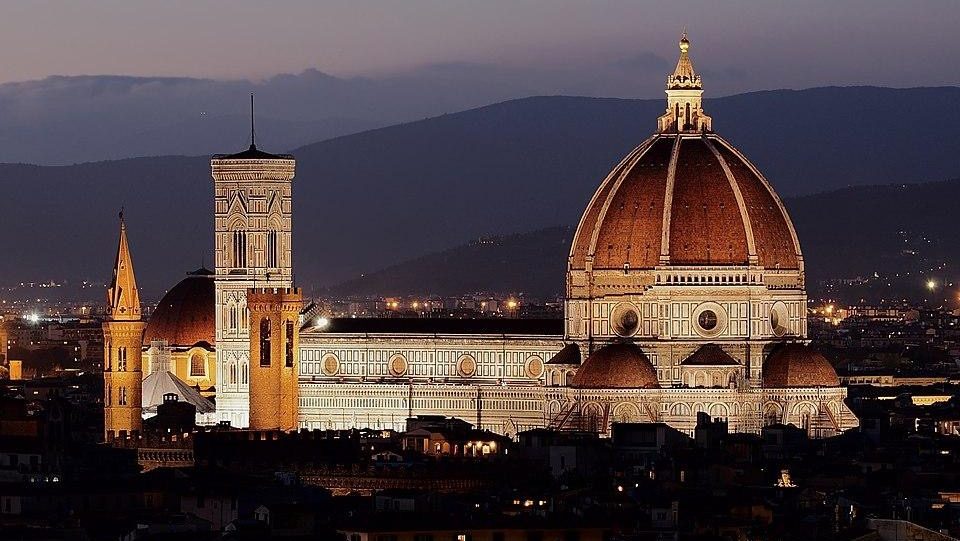
Although this allowed the Ghibellines to resume control of Florence, their rule was disastrous. After seeking the aid of Pope Clement IV, he restored the authority of the Guelfs (who, of course, favored the authority of the Pope). This allowed Florence to flourish and prosper once again through the rest of the 13th century. It’s during much of the 13th century that the mendicant orders, the Franciscans and Dominicans et al., arrive to Florence and begin building their convents. Artists made significant altarpieces. Santa Maria del Fiore (minus the dome built by Brunelleschi) was begun in 1294 and Palazzo Vecchio was built in the same period. It’s in this timeframe that Florence was established as a republic. Siena’s financial power began to falter as Florence’s came to prosper, with Florence eventually becoming one of Europe’s banking and financial capitals; banking families established branches in major trading and mercantile centers across Europe, only aiding in the broader circulation of the florin.

Keep in mind that banking is not just about minting coin: it’s about offering credit at interest (a minor interest) to potential investors. Ideally, those investors can use that credit to build businesses and then use that income to pay the bank back. It’s infinitely more complicated than that, but that’s how it boils down with regards to medieval finance. This is made especially apparent by the fact that these banks were owned by private families like the Peruzzis. Florence’s banks were powerful and stable, helping Europe’s economy to flourish and expand during the 13th and early 14th centuries. Even though the Guelf-Ghibelline conflict continued, the strength and importance of the financial economy displaced political instability.


The Black Death and Economic Collapse
It’s in the early decades of the 14th century that the likes of Giotto and Dante worked and thrived. Florence became an essential cultural leader in this period. While Giotto set the standard for naturalism and a human approach to religious art, Dante was among the first secular writers and wrote in Tuscan Italian (which is now the basis of modern Italian). Unfortunately, Florence’s powerful banks went bankrupt during a European-wide recession in 1340. Any recovery that was made was destroyed completely by the devastation of the Black Death in 1348. Florence, as a populous trading centre, was very hard hit: anywhere from ⅓ to ½ of Florence’s population perished; Florence was not able to recover pre-plague population numbers until the 19th century.

Even though Boccaccio and Petrarch wrote their greatest works in the wake of the Plague, like much of Europe, it took a few generations for Florence recover. Another benefit that emerged was that with many fewer people available to work, they were able to eke out better wages from landowners/employers. However, this was not entirely the case: the Ciompi Revolt, which was begun by disgruntled wool workers, lasted between 1378 and 1382 and ended in the victory of Florence’s wealthy.
From 1389, Duke Gian Galeazzo Visconti of the powerful city of Milan endeavored to capture the whole of Tuscany and engaged with Florence in three wars that lasted from 1390-2, 1397-8, and 1400-2. It should be noted that Giovanni di Bicci de’ Medici established the Medici bank in 1397. Florence, who hired powerful mercenary armies with its enormous financial resources, beat back Milan during the first two wars (although it struggled during the 2nd war). By the third war, Visconti had crushed Florence’s allies, aided by much backstabbing and betrayal. Astonishingly, an outbreak of the plague is what saved Florence: it devastated Tuscany and Lombardy, even managing to kill Gian Galeazzo Visconti. In the wake of his death, Florence purchased Pisa from Visconti’s heirs, solidifying their dominance of Tuscany for the time being.
Leave a Reply