
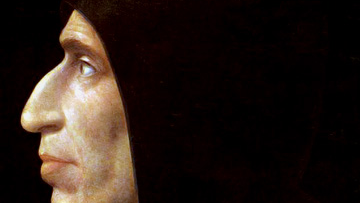
When Florence Succumbed to a Cult like Pawnee, Indiana
The Rise of Savonarola: Prophecy and Popularity
In the meantime, Lorenzo’s health declined considerably and he ultimately died from his many ailments in 1492. He was succeeded by his idiot son, Piero the Unfortunate. Less than two years later, Charles VIII of France invaded Florence. Piero was quickly deposed by angry, panicking mobs who were fuelled by Savonarola’s “prophetic” rhetoric. Savonarola then managed to dissuade Charles VIII from attacking the city, who soon left to continue his journey; Florence was spared and the city willingly came under the rule of this cult leader. Savonarola embarked on a crusade to purify the city of any pagan, sinful influences. He enacted anti-vice legislation, censuring the rather liberal culture that had existed through the Renaissance. He sponsored bonfires that encouraged Florentines to burn any “pagan” objects; Botticelli himself threw some of his paintings into the fire in repentance. Sad. He even created a creepy secret police of men and boys who patrolled the streets of Florence, enforcing this new strict code.

Savonarola had also started attacking the Church, much to the ire of Pope Alexander VI (who had several children, by the way). Savonarola’s writings and sermons against the Church, with an emphasis on personal piety, circulated through Switzerland and Germany and are viewed as proto-Protestant writings. Keep in mind that Luther’s Reformation began in earnest within a few decades.
The Execution of Savonarola, 1498
Obviously, this only furthered Alexander VI’s outrage, who threatened Florence with dire consequences if they allowed Savonarola to continue with his antics. The government twiddled their thumbs while Savonarola continued to fancy himself a prophet. Some Franciscan friar suggested a trial by fire—if Savonarola survived, then he was a prophet. The date of 7 April was set but a rainstorm prevented the proceedings from happening. Spectators thought Savonarola did it and attacked San Marco. Savonarola and two colleagues were arrested and imprisoned and Savonarola was tortured to confess his false prophecies…then he recanted and then he confessed again. 23 May 1498, all three were convicted of heresy and schism. They were then hanged while a fire was lit below them. Their ashes were scattered in the Arno River. Here’s a plaque marking where they were executed!


The Restoration of the Republic and the Return of the Medici
The Republic of Florence was reinstated in 1502 with Florentines electing Piero Soderini as head of government. He and Machiavelli introduced a standing army to Florence in 1509, negating the longtime use of mercenaries, and captured Pisa that same year. Cardinal Giovanni de’ Medici (son of Lorenzo il Magnifico) captured Florence in 1512, deposing Soderini and Machiavelli. Cardinal Giovanni was elected Pope Leo X in 1513. He thereafter established a proxy government led by cousins Giuliano and Lorenzo II de’ Medici (the latter was father of Catherine de’ Medici, future Queen of France). Lorenzo died of syphilis in 1519 and was replaced by Leo X’s adopted brother/cousin, Cardinal Giulio de’ Medici until 1523 when he was elected Pope Clement VII upon his brother’s death. Thereafter, he appointed first cousin once removed, Ippolito, and first cousin twice removed, Alessandro, to rule Florence in his stead. After the sack of Rome in 1527, Republican forces once again drove out the Medici. Several years later, Clement VII sacrificed the city of Florence to gain his freedom from Charles V’s imprisonment and the restoration of the Medici, which occurred in 1530. They became the de facto rulers of Florence once again and were even given the honorary title of duke. A member of a different branch of the family, Cosimo, became the official successor in 1537 due to the original branch dying out. His power only grew and he was given the title of Grand Duke of Tuscany in 1569. And thus ended the Republic of Florence.
With this outline of the political history of Florence, it is now possible to dive into some of the art that emerged from the city.

Leave a Reply