
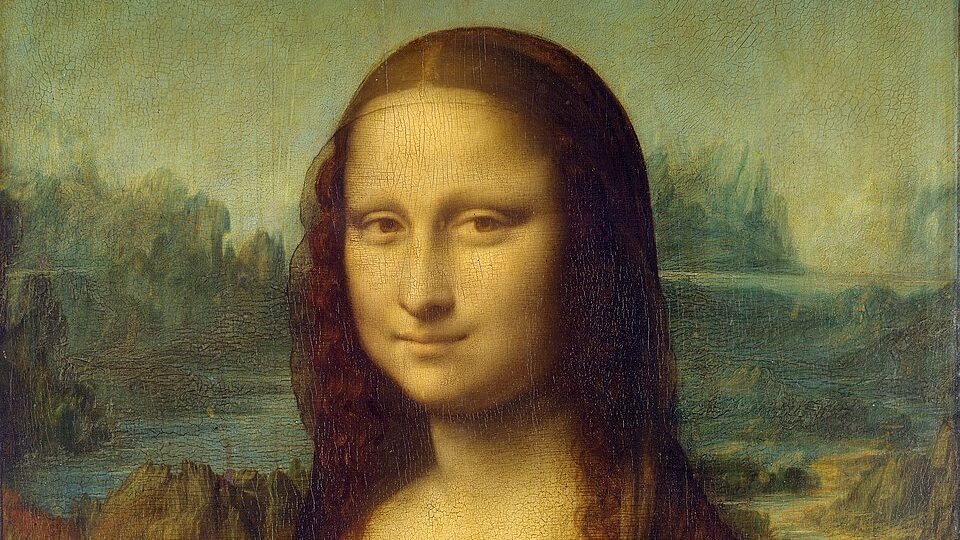
Mona Lisa/La Jaconde/La Gioconda
This finally brings us back to the Mona Lisa. This is not an early portrait by any means, but it was still a relatively new genre in the early years of the 1500s—particularly compared to altarpieces. But Leonardo’s seems different for some reason and is closer to Jan van Eyck’s. Now, if anything from Dan Brown’s stupid book or anything from the History Channel has popped into your head, please. For the love of God. Stahp. The answer lies in Leonardo’s artistry and the visual culture from which he learned. This was a man who wanted to know and understand everything. In addition to the idea of flight, he also was obsessed with: how the eyes and mind see and perceive the world; how he could achieve the illusion of corporeality on the canvas/wood panel/wall/etc. We know this from his notes, which survive in huge numbers.

Leonardo painted the background landscape using the sfumato technique. This is a layering technique that gives an image a foggy appearance (atmospheric perspective), thereby enhancing the illusion of depth. Mona Lisa herself also has a glowing fogginess, which gives the illusion that she is sitting in and amongst the hazy atmosphere. Leonardo’s atmospheric perspective technique is key to lending this painting the illusion of corporeality.
But what about the oddities of her face?
Leonardo wanted to create a hyper-realistic piece; part of that is humanizing the sitter. Leonardo understood that people look each other in the eye when they try to connect deeply. People also tend to have some slight expression to show (or feign) interest. This humanization was not part of many early Renaissance portraits (many of which were profiles) with some rare examples mentioned above. Keep in mind that Jan van Eyck and Ghirlandaio were two of the best painters of their day. Even then, there were techniques (such as atmospheric perspective) that were much less developed technically that took a genius like Leonardo to hone and develop. This is what makes Mona Lisa so unique and special: it’s the illusion of humanity, not just corporeality. And that uncomfortable feeling you get looking at it? That’s just the Uncanny Valley (think Polar Express). Just because the term was created in the 1970s doesn’t mean that it doesn’t apply to other images outside of modern media; Leonardo was hundreds of years ahead of his time.
There are some other things to clear up. Her hands are on display because wealthy women used their soft, delicate hands as status statements (compared to most women, whose profession was backbreaking labour to run and feed a household). The reason why she had a high hairline and no eyebrows was because she was fashionable (yeah, I don’t get it either).
Okay? This is the point of the painting.
After the Commission
Now. Leonardo was notorious for not finishing projects. He had a tendency to bite off more than he could chew and overcomplicated his projects to the point where he’d never finish (there are lots of examples). But the things he did do always caught the eye of powerful patrons. Leonardo left Florence for Milan again in 1508, taking Mona Lisa with him. He worked under the duke of Milan (VERY powerful man) until he caught the eye of Francis I of France in 1513. He remained at the French court until he died without issue in 1519. As a consequence, all his worldly possessions (presumably) got absorbed into the French Crown.
Eventually, the Louvre was opened as a museum in 1793 during the First French Republic. Mona Lisa was put up at some point but it was considered to be a minor painting of his (as historians argue today). Personally, I think it was a sort of tablet for his theories about optics (which would explain why he never let it go). So why did it become such a big damned deal? It was stolen in broad daylight in 1911. This made international headlines and gave people a sensational story that sold many papers. And then it was mysteriously returned in 1913, feeding the beast.
And flash forward to 110+ years and people are still obsessed with this painting. Hopefully now you understand it a bit better.


Leave a Reply