
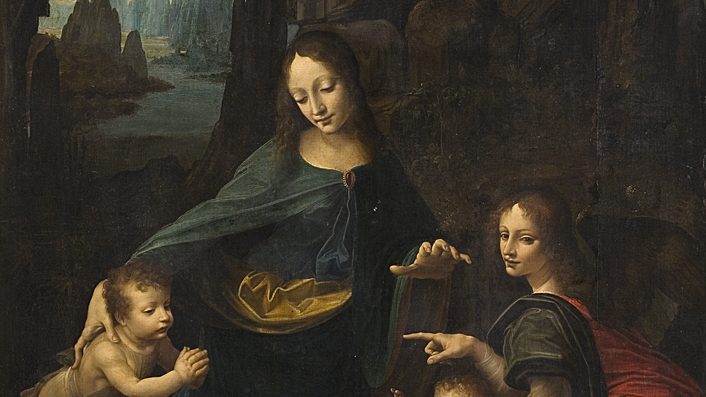
Now what’s the broader historical context that can help us understand this painting better? Why would Leonardo endeavor to create such high degrees of spatial and human naturalism in this image? Well, for one, Leonardo himself was obsessed with making things as illusionistic as possible, as evidenced by his sfumato and atmospheric perspective techniques. See Mona Lisa, Madonna of the Rocks, Ginevra de’ Benci. But, this is also a mural and we are lucky it’s remained in the same location for 500+ years. Paintings from the medieval and Renaissance period always had intended locations and it’s best to try and examine them within their spatial contexts. This is much easier to achieve with frescoes (or, in this case, murals). As I said before, this is located in the refectory of the Dominican convent of Santa Maria delle Grazie in Milan, which was built between 1463 and 1497 with the sponsorship and funding of Francesco Sforza, father of Leonardo’s patron, Ludovico. What was a Dominican convent or friary?


Preaching, Building, and Burying by Caroline Bruzelius, professor emerita at Duke University, does a fantastic job explaining how the Dominican mission intertwined with paradigm shifts in urban planning and religious practices during the 13th and 14th centuries. While her focus is on Italy, she makes it clear that these patterns could be found across western and central Europe. The Friars Preacher, or Dominicans, was a movement founded by St. Dominic in Spain to preach to the lay public and convert them from heresy and/or keep them in the fold. Although we think of the Protestant Reformation of 1517 (started by Luther) as the first reform movement, it actually was the first successful reform movement. Dissent began as early as the 12th-15th centuries with the Waldensians, Lollards, and Hussites (there were more, but these are the big ones…also, arguably, the Moravian church is the first true Protestant church because it maintains many of the theological teachings of Jan Hus). The Church had come to be seen as an ostentatious institution for the elite, which is why those movements were so attractive to the masses: they preached apostolic poverty and service of the poor and the meek. St. Dominic’s rule sought to retain Church laity by preaching about those very same issues! And he declared that Friars Preacher would practice institutional poverty, too. Bruzelius discusses how their mission stood in stark contrast to the meditative, penitent one of traditional monastic orders like the Benedictines and this difference is reflected in where they were located: Benedictines and their ilk were rural (perhaps a few hours’ walk away from an urban center, like the Abbey Church of St Denis, or in the middle of nowhere, like Monastery of St Martin in Canigou, France); Dominicans and their ilk were urban, as seen in Santa Maria Novella or San Marco Friary in Florence.
South of the Alps, Dominicans acquired land and buildings to practice what they preached (ha!) through lay donations, by and large. From the very earliest years of institutionalization in the 1210s, their architecture mimicked monastic architecture because it provided proper spiritual, intellectual, and physical accommodations for an active clergy; Dominicans just adapted it to an urban setting. These complexes largely included church, dormitory, library, chapter house and oratory, and refectory. All of the buildings were situated around a cloister. The same could also be said about friaries north of the Alps, with the exception being how land and buildings were acquired: through the generosity (and guilt!) of the aristocracy and royalty. Case in point is that Alexander II, the king of Scotland, provided the land and funding for a Dominican friary in Edinburgh as early as 1230 (!) and James IV provided the land for a Franciscan friary in Edinburgh in the mid 15th century.
Part 3 of The Last Supper is forthcoming. In the meantime, take a look at our recommended readings:

Leave a Reply