
Part 6: July Page
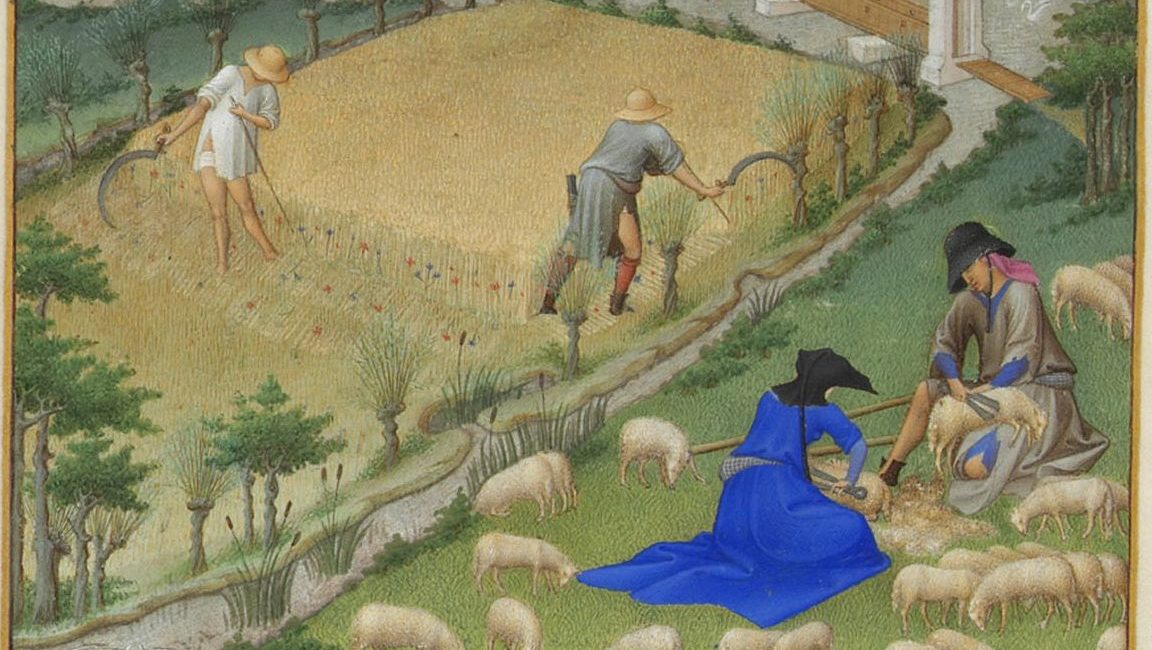
The July page depicts the summer harvest and shearing of sheep in front of the Château of Poitiers, extravagantly enlarged and decorated by the duke of Berry himself (Château de Chantilly https://les-tres-riches-heures.chateaudechantilly.fr/). The mountainous landscape surrounding the castle signals its remote location—this building defined the landscape and the community that inhabited it. The castle is surrounded by a moat and gives access via bridges and gates (in the right corner of the wall facing the viewer and on the left side of the page). There are only a few small windows at the top of the castle and above the main entrance. Each corner of the triangular structure is occupied by round towers. Indeed, this building was intended to be defensive in nature. However, the gabled windows in the right side of the building have elaborate fenestration, signifying the lord’s suite of rooms. Comfort and extravagance were incorporated into this powerful structure.

As mentioned above, the agricultural activities of the summer harvest and the shearing of sheep take place in the area surrounding the castle. If you remember, the medieval open-field system—the area surrounding the manor house/castle—there were three fields: one reserved for spring planting; one reserved for autumn planting; and one left to lie fallow. Harvesting took place in summer and autumn. In Northern Europe, barley was the dominant grain but wheat was grown as a cash crop. Meanwhile, sheep were primarily raised for wool as another cash crop. They were not typically raised for slaughter—not compared to pigs, anyway. July is a good time to shear sheep because wool is warm and July is hot. I’m sure you put that together in your head already but it’s bears repeating.
Once again, we see the men carrying out the summer harvest dressed in long shirts and undergarments; one of them wears stockings and shoes. The woman shearing the sheep in the foreground wears a head-covering to shade her eyes, as does her companion in front of her. Unlike the men in the background, he wears a long shirt underneath his tunic, as well as shoes. This stands in stark contrast to the half-naked man on the left side of the page. I want to avoid overanalysing, but this is a good opportunity to bring up that peasants were not uniformly impoverished. Some peasants, in fact, could be quite well off if he was able to acquire more rental landholdings. As with the aristocracy, this could be done through advantageous marriages. Furthermore, the bigger one’s flock, the bigger one’s stock. At the same time, bigger flocks required more investment in resources and time to maintain healthily. Livestock quantities directly reflected a farmer’s wealth. Furthermore, both types of agriculture here are shown as being plentiful. And so, in addition to a hint of voyeurism as we have seen in previous pages showing peasants, this page also displays the bounty of the duke of Berry’s landholdings. Once again, we have a lil’ self-pat on the back. The next page is unique in that it combines scenes of aristocratic and peasant life into one image.
Leave a Reply