
Part 8: September Page
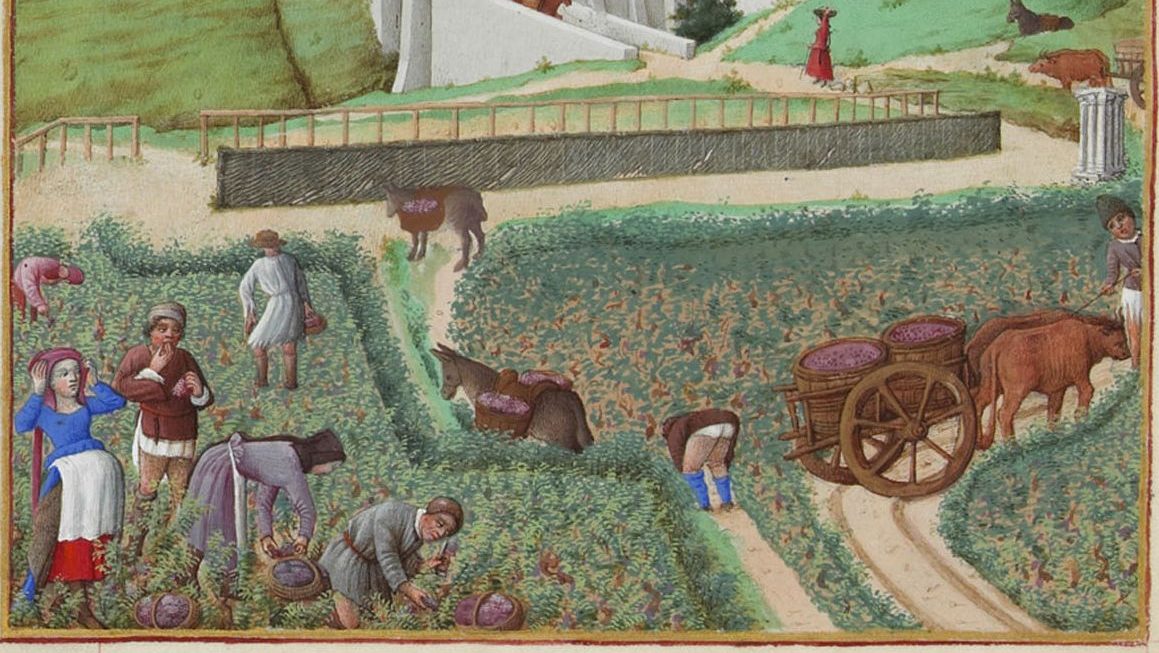
This page was painted in two phases. The first was from 1438-1442 for King René of Anjou; the second was painted by Jean Colombe for the duke of Savoy in the 1480s. The foreground depicts a grape harvest, with a group of peasants quietly plucking away in the vineyards in the bottom left corner. One female figure has rosy cheeks and a rounded belly—a clever little depiction of a pregnant peasant taking a quick rest from the backbreaking labor. The man standing behind her cheekily snacks on a bunch of grapes rather than place them in with the rest of the harvest. Naughty! A team of oxen drag away giant collections of grapes in the right foreground of the image. A donkey stands patiently on the road dividing the two vineyards while a man bends over, showing us his rear end. Even though this image dates from after the duke of Berry’s death by decades, the same voyeuristic tone remains the same. It shows us how this stratum thought of the peasants who worked beneath them: as vulgar and ever-pregnant.

Behind the vineyards stands a stockade with wicker parapets. This space was intended for knightly jousting. We once again encounter the themes of landownership, how the land was employed, and who was permitted to use it. The peasants were permitted to use the land for labor. However, part of this labor was paid to the manorial lord. The landlord, meanwhile, was permitted to use it however he chose. Sports like jousting were exclusive purviews of the elite, who were trained from an early age in these knightly pursuits. Even though jousting existed alongside the vineyards, there remained a sharp hierarchical divide between the people who occupied this space.
Behind the jousting parapet is the Château of Saumur. Although elaborately decorated, we can tell that defense remained an essential element of intention based on the thick, windowless walls beneath the decorative section of the castle. It is surrounded by deep ditches on all sides. The only way to access the castle from this angle is the long bridge and gate in the middle section of the image. Behind the gate are the kitchens, which are clearly located at some distance from the castle. This was done as a way to deter fire: if the kitchen burned at a distance from a castle, there was a lower chance of it spreading to the main castle. There’s no point in building a big ol’ castle to defend everyone if it burns to the ground!

Leave a Reply