
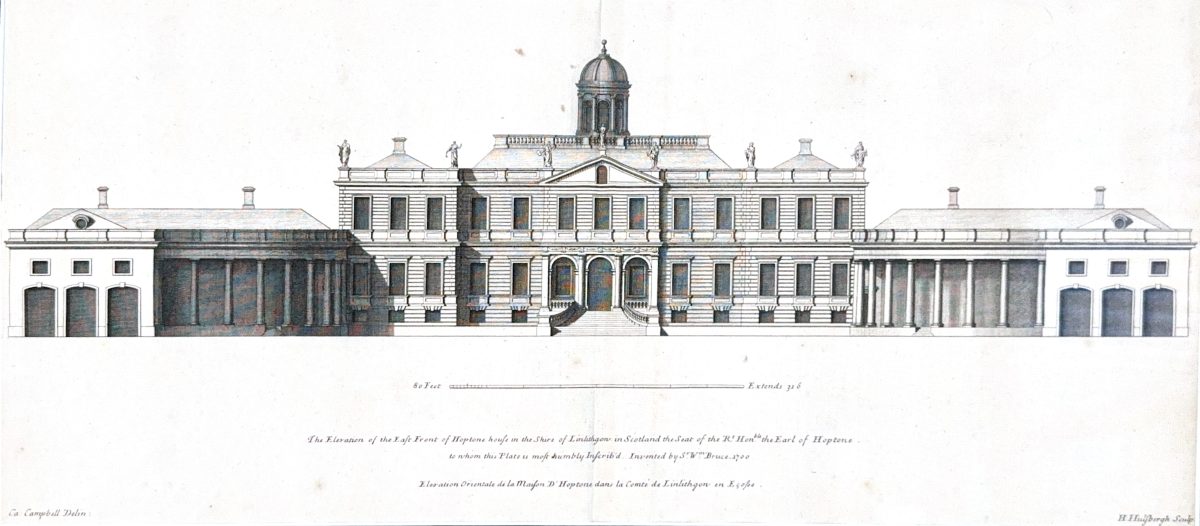
My book, The Estate and the Country House in Scotland, Circa 1700: a Case Study of Sir William Bruce’s Hopetoun House, is due to be published by Edinburgh University Press in September 2026. The elements discussed in this Hopetoun essay series are the focus of my book.
Getting Started
The eighteenth-century Scottish country house was much more than a pretty and exquisite mansion surrounded by manicured gardens. This building type is a significant field in Scottish architectural history because it provides ample insight into contemporary architectural theory, fashion and taste, and the exchange of ideas. However, this project takes several unique approaches. The first is that it studies the country house within the context of the estate and the land management. Additionally, it makes use of a single case study of Hopetoun House to permit deep, interdisciplinary analysis. Built by landowners who worked to maximise the profitability of their many landholdings, Hopetoun embodied the massive socio-economic paradigm shifts that took place during the 1700s in Scotland. It was built approximately thirteen miles northwest of Edinburgh between 1699 and 1707 by the Hope family (which obtained the title of earl of Hopetoun in 1703) and was intertwined with the movements of agricultural improvement and the industrialisation of the land.

Archival-based research
Archival research has been essential to peeling back the layers of this project. The National Library, National Records of Scotland, Glasgow University Archives, Records of the Parliaments of Scotland, and, most importantly, Hopetoun Papers Trust have all provided key insight into the complex, dynamic period of the turn of the eighteenth century. Although a few documents filled in missing pieces, the archival work I performed required a fine-toothed comb, meticulous focus, and great patience. Luckily, Hopetoun Papers Trust houses a treasure trove of materials relating to the commission, design, and construction of Hopetoun, as well as the management of the surrounding estate and the owners’ (the ancestors of the present marquessate of Linlithgow) many other landholdings. Indeed, Hopetoun Papers Trust contains hundreds, if not thousands, of papers relating to the commission, design, and construction of the house itself, as well as the management of the surrounding estate and the family’s many other landholdings (such as their mines at Leadhills in Lanarkshire). The great challenge was parsing through this mountain of materials. I was able to comb through and study hundreds—if not thousands—of papers that gave me great insight into the house and the family’s expansive estate.
Continue reading the Hopetoun House essay series here:
Introducing Hopetoun House · 2 of 3
Next Essay
Part 2: A Dynamic Complex
←or try a series
History of Florence, Part 1: Antiquity and Early Middle Ages

Leave a Reply