
15th-century artists sought to naturalize and classicize their works, even if the subjects were religious. This was a direct reflection of the renewed fervor for Antiquity with the import of “lost” Greek texts. Let’s explore some examples:
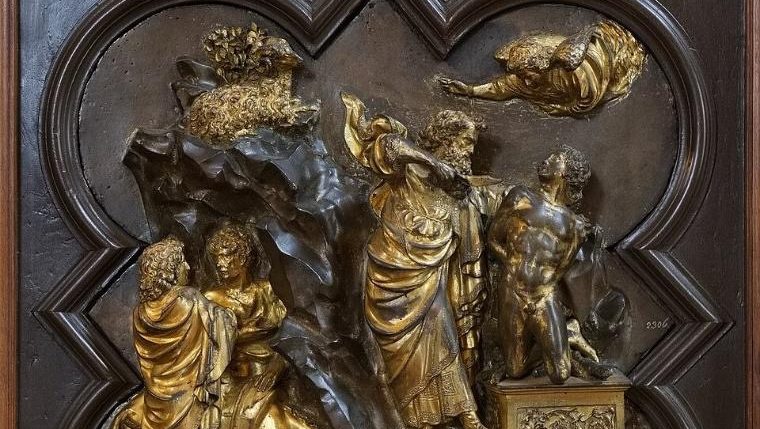
Ghiberti, Sacrifice of Isaac, ca. 1400-2.
- The arte di calimala (the cloth finishers guild) hosted a competition for the commission of the east doors of Florence Baptistery facing the cathedral (those doors were moved to the north side of the baptistery a few decades later). There were to be 24 panels sculpted in bronze and the challenge that was set was to create a scene depicting Abraham’s near sacrifice of Isaac (Book of Genisis) using that same panel. A number of competitors entered the competition, including Ghiberti, Brunelleschi, and Jacopo della Quercia. The two finalists were Brunelleschi and Ghiberti, with the latter ultimately winning the competition. Not only was this panel made of one single piece of hollowed out bronze (except for Isaac), saving resources and money, it is a dynamic image. Ghiberti creates a more vivid depiction of space and more dynamic figures.
He has an astute understanding of human anatomy—especially in a time when anatomical study was highly illegal—and positions Abraham in the classic contrapposto stance. It’s a very physical and dynamic depiction of this scene, showing the early effects of humanism and classicism on visual culture. This is typically considered to be one of the earliest objects of the Renaissance.

Nanni di Banco, Four Saints, Orsanmichele, Florence, ca. 1410
- Orsanmichele was built in 1337 as a communal grain storage building in Florence: everyone paid a grain tax and a portion of that grain was stored therein. It was a social safety net in the sense that if there were a poor harvest or two, there’d be spare grain that could be apportioned to Florence’s citizens to prevent famine. It was then partially converted into a chapel for Florence’s guilds (basically, the medieval version of civil unions) between 1380 and 1404.
If I remember correctly, its function as a grain storage facility remained on the second storey—we can see that with the open windows. At the end of the 14th century, the guilds agreed that they would commission statues of their patron saints to adorn the decorative niches on the outside of the building. This is one of the earliest objects that was completed and installed.

So, confusingly, this object represents the four crowned saints, a group of nine early Christian martyrs. Christianity was illegal in the Roman Empire from the death of Christ to Constantine’s issuance of the Edict of Milan in 313; Christians were highly persecuted in that period. As such, a lot of the early saints were these clandestine Christians who got discovered and executed (or martyred) for their faith. This group of martyred saints were the patron saints of the stone and woodcarvers guild in Florence. These figures are not just individually designed where they each have their own distinct face, they are also arranged together. Some figures have their mouths open as if they are midsentence while others look on as if they’re listening intently. In other words, they are engaged with one another, huddled together as if in hushed and harried conversation. When we keep in mind that these saints were martyred, we realise that they are making the decision to sacrifice themselves rather than denounce their faith.
And yet, they look like they’ve stepped aside to create a gap in the circle, inviting us into their group; their toes peak out over the edge of the niche. This is very purposeful: they physically step out of their divine space and into our corporeal world and they are inviting us to be part of theirs. This is a very human and naturalistic depiction of divine intervention. Moreover, they are standing in contrapposto and are dressed in togas like ancient Roman patricians (philosophers, senators, etc.). Nanni di Banco was looking to objects of Antiquity for inspiration and consciously depicted this figures as they would have appeared (or how he thought they would have) when they were alive. It was a way to link modern Florence to their ancient Roman past. And this really is the essence of the early Renaissance: adapting ancient Roman philosophies, aesthetic, etc., to a modern, Christian world. Indeed, the Renaissance is characterized as a “secular” period…but it is clearly not.
Donatello’s St. Mark, Orsanmichele, 1411.
- As with the previous example, this is another classicized depiction of a Christian figure—in this case, Mark the Evangelist (of the Gospel of Mark). He is depicted as an ancient Roman figure in a toga and standing in contrapposto. He carries a tablet in his left hand and looks up to the heavens. In other words, he’s receiving divine inspiration to record his gospel.

There are many such examples of these kinds of works. I won’t go on and on, but hopefully you get the idea. Although the product of over a century of steps in this direction, it’s in the early years of the 15th century that we see the Renaissance come out in full force.
Leave a Reply