
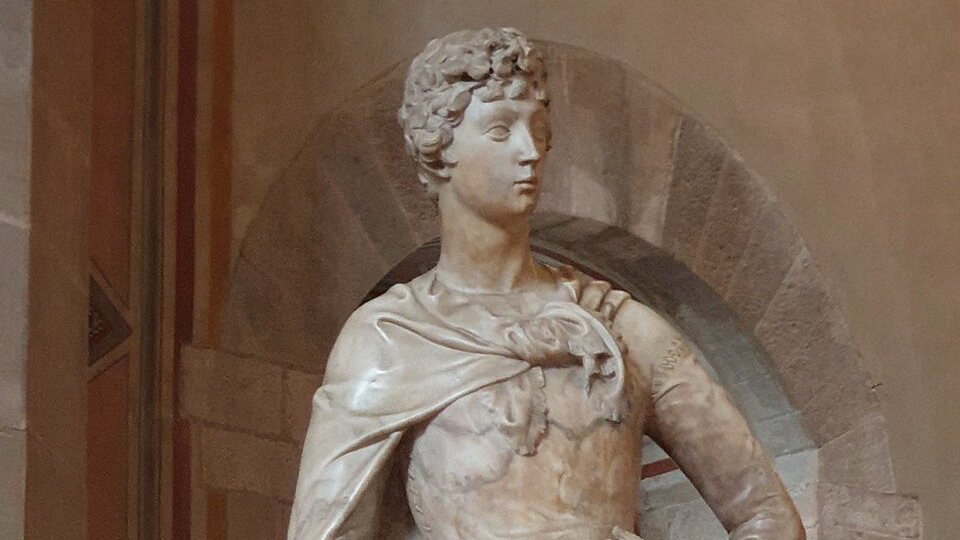
The Operei and the Duomo’s Decorative Programme
Florence in this period had also only just been saved by seemingly divine intervention from being crushed by Gian Galeazzo Visconti—the final war lasting from 1400-2. Their civic pride was undoubtedly through the roof and they found themselves free from war and able to invest in beautifying their city.

We see this manifested in the number of decorative programs dotting the city. In addition to the new set of bronze doors at the Baptistery and the new decorative program for Orsanmichele, the overseers managing Santa Maria del Fiore, the operei del Duomo (who were laymen of some standing in the city, often members of the arte della lana, or wool merchants guild), came up with yet another decorative program for the cathedral at the beginning of the fifteenth century.
It was decided that the buttresses of the cathedral would be surmounted by 12 statues of the prophets. The first two commissioned were Donatello’s David (1408) and Nanni di Banco’s Isaiah (1408), but both were too small to be visible from the ground. David as a subject held another deeply significant connotation as a symbol of Florence.

The David as Florence’s Cultural Symbol
The story of David, of course, is that a young King David defeated the mighty Philistine warrior, Goliath, using just a sling and thereafter cuts off his head in victory. Florence, particularly in the early decades of the fifteenth century, had achieved this type of victory over and over again. Donatello’s David from 1408 is not the only statue to emerge of this figure.
He created another one a few decades later in ca. 1440; it’s the first full, in-the-round nude statue created since Antiquity. It is known to have been situated on a pedestal in the courtyard of Palazzo Medici by 1469. This idea of David as a symbol of Florence got bastardized by the Medici by this period in the sense that they viewed David as their symbol: they’d overcome their many rivals to become Florence’s unofficial rulers. Indeed, they commissioned another version of David from Andrea del Verrocchio and it was sculpted between 1473 and 1475. Like Donatello’s second version, Verrecchio’s David is a young boy on the cusp of puberty, albeit clothed. All three Davids stand victoriously over the head of Goliath, signifying the victory of Florence (1408) and the Medici (1440 and 1470s).


Meanwhile, back at Santa Maria del Fiore, Donatello made a terracotta statue of Joshua (1410) and another of St John the Evangelist (1409-11), neither of which were lifted into place. Donatello also carved Beardless Prophet and Bearded Prophet (1415), Sacrifice of Isaac (1421), Habbakuk (1423-5), and Jeremiah (1423-6), all of which were subsequently mounted on the Duomo’s Campanile (belltower). Agostino di Duccio created a terracotta figure of Hercules in 1463 and was subsequently commissioned to create a 17’ tall statue of David to replace where Donatello’s was originally meant to go. He halted work for whatever reason in 1466. Antonio Rossellino was recruited in 1476 to complete the project but never even began.
The block sat in the yard of the cathedral workshop for the next 25 years until Michelangelo won the commission in 1501 when the overseers decided it was time do something about it. All of the objects cited above trace Florence’s history through the height of the Republic, the rise of the Medici family, their dramatic fall from grace and replacement with cult leader Savonarola, and the restoration of the full-fledged republican government in 1498. By the turn of the sixteenth century, David had come to be a symbol of Florence once gain but this time representing the republican government’s victory over corruption and civil strife. Piero Soderini was elected in 1502 in the middle of Michelangelo’s work on the David and with it the belief and hope that stability and normalcy had returned.
Leave a Reply