
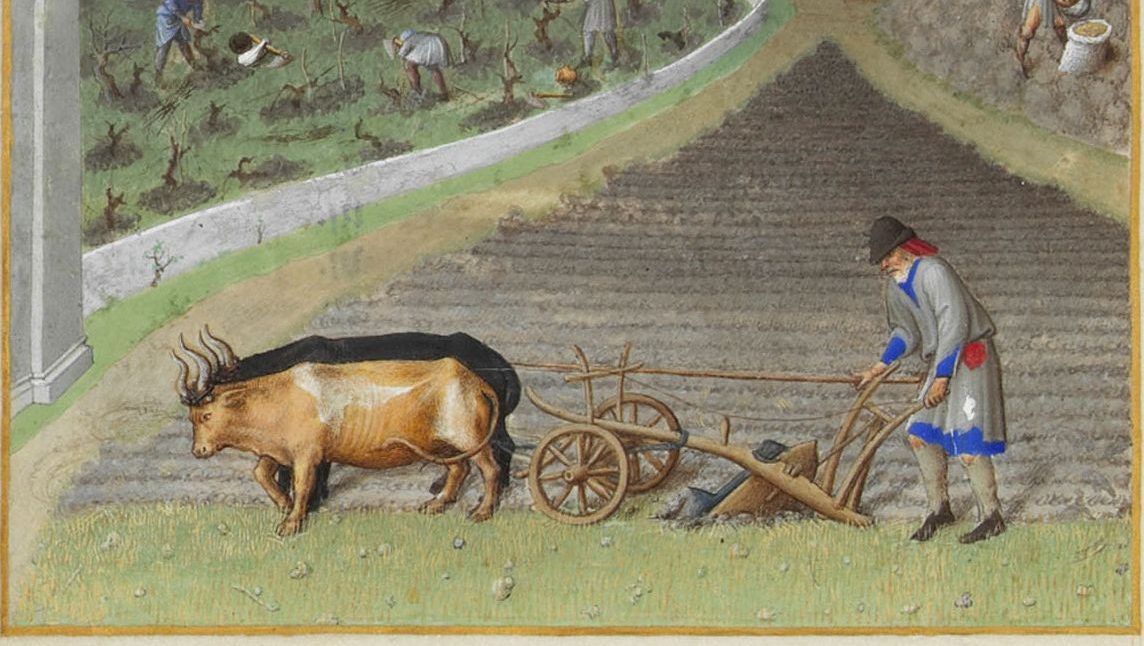
Part 3: March Page
This page depicts another peasant scene with Château de Lusignan in the background, standing as an important reminder of the power and presence of the duke of Berry. The peasants working the land were ever cognizant of the lord under which they labored. The tasks specifically performed by the peasants here were ones that readied the land for the growing season. In the foreground, a farmer with a team of oxen plough a field. In the background on the left, three men tidy a vineyard by picking up sticks and bundling them together. I’ll be honest, I’m not quite sure what the man in the background on the right is doing. The field upon which he stands is unprepared based on how the Limbourg brothers depicted it as clumpy and uneven. However, the peasant also stands next to a sack while holding some sort of vessel. I do not think he is sowing the field but he is perhaps fertilizing it.

With all that said, this scene gives important insight into medieval agricultural practices. Let’s talk about that for a little bit.

The agricultural history of northwestern Europe is directly tied to the evolution of land management and how it was organized. In the Middle Ages, particularly the late Middle Ages, the land was divided based on landownership. The more land one owned, the greater one’s power, wealth, and influence. This is because the land was tied to agricultural production. Earlier in the Middle Ages, the feudal form of land tenure was standard, where serfs worked in a bondage of debt for their lord in exchange for military protection. As banking became more sophisticated and cash flow more stable, and the devastation of the Plague took its toll from 1347 to 1351 (and fewer people gave peasants more leverage against their labor-starved lords), a shift began to emerge towards tenancy: farmers paid for the use of the land directly to the landlord.
The lord’s demesne (the land held by the lord) was organized in the open-field system. In Northern Europe, this meant that the demesne was divided into three fields: one left for spring planting; the second for autumn planting; and a third left to lie fallow. An elementary form of crop rotation was employed to help revitalize the soil each year. The cultivated fields themselves were parceled into strips to be individually cultivated by tenants and they were ploughed with deep ridges and high furrows; this not only helped mark the division of land, but also helped with drainage.

A fourth field was left as common land, which allowed tenants’ livestock to graze communally. Woodland was also left for tenants to allow pigs to graze. Side note: medieval pigs were much closer to boars in that they were hearty and hairy and grazed in woodlands for sustenance. They were not the pink, rather immobile creatures we know and love today. Privately held land for purposes such as orchards was enclosed as closes.
Although feudalism, defined by peasants working the land in exchange for military protection, gradually phased out, the model of the relationship between peasant and lord remained. Peasant farmers worked the land communally (especially when ploughing because ploughs and teams of oxen were expensive tools few could afford individually). They paid for this right to their lord or a rich tenant farmer who had acquired more land in tenancy.
So when we look at an image like the March page, we are not observing individual farmers who own the land outright. We instead are looking at people who worked the land communally and who owed their right to the land to their landlord. Based on the March page, the duke of Berry certainly viewed his relationship with the many peasants who worked under him in this light.
Leave a Reply