
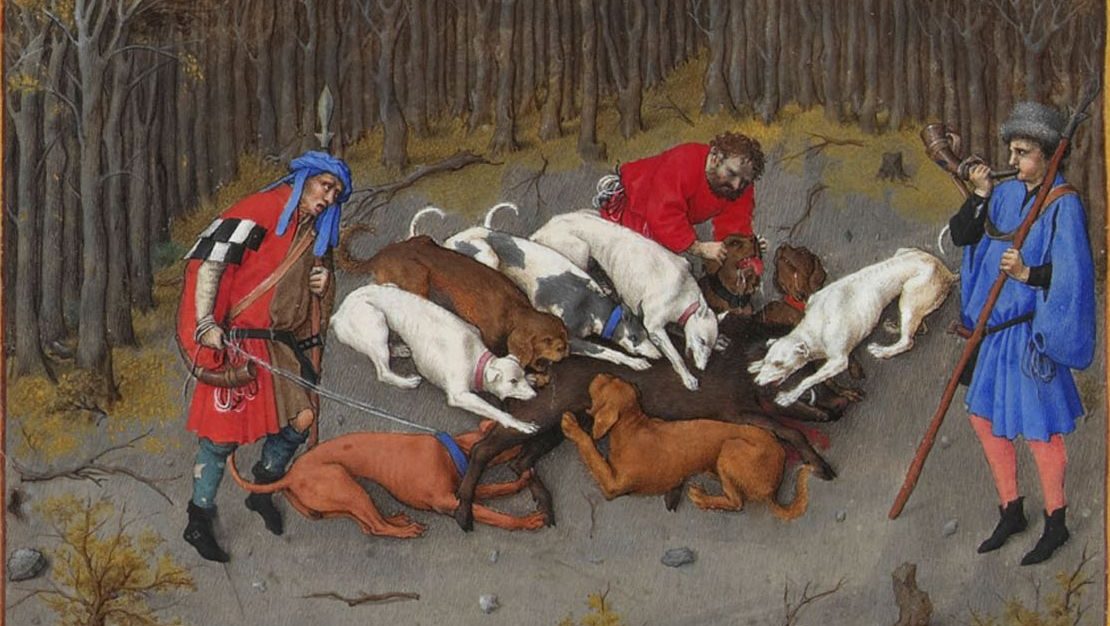
Page 10: December Page
And here we are at the end of the calendrical year of Les Très Riches Heures du Duc de Berry with the December page. This page depicts the prestigious, highly prized pastime of the boar hunt. Hunting was not just a fashionable sport across Europe: it was essential to the lifestyle and training of European nobles. Indeed, ‘at its heart, hunting involves an attempt to pit human wits against the wiles of the natural world.’1 Hunting represented an aristocrat’s dominance over his land, as well as his strength and vigour; this sport was the embodiment of noble masculinity. Richard Blome sums up this philosophy best:
‘To tell you that Hunting is a commendable Recreation, and hath always ben [sic] practiced and highly prized by all Degrees and Qualities of Men, even by Kings and Princes; that it is a great preserver of Health, a Manly Exercise, and an increaser of Activity; that it recreates the Mind, strengthens the Limbs, and whets the Stomach; and that no Musick is more charming to the Ears of Man, than a Pack of Hounds in full Cry is to him that delights in Hunting, is to tell you that which experimentally is known, and what hath been sufficiently treated by others.’2

Hunting was as much, if not more, about the ritual as it was about the pursuit and capture of fresh meat. Good horsemanship was part of this ideal since hunting was carried out on horseback. According to Keith M. Brown, ‘hunting encouraged good horsemanship and the horse was a potent symbol of royal and noble authority, riding being praised as a noble art by antiquity, and the mastery of the horse being a visual demonstration of rulership.’ Hunting was considered key to training for war and developing martial prowess, which together comprised the most important purview of young, virile, male aristocrats. Furthermore, ‘hunting was more than a sport, being a means of defining nobility, its complex rituals reinforcing hierarchy’ and ‘was also an essential part of young noblemen’s education and was central to their socialization.’3 In addition to being an expensive pastime outside of the reaches of the vast majority of Europe’s population—requiring land, well trained horses and dogs, servants, and leisure time—it was the chief means of aristocratic socialisation (golf is very similar in that fashion in the 21st century).
Several hunting methods developed in the Middle Ages and varied in popularity in each region of Europe. The two most common hunting methods in Western Europe were the chase and the drive. The former was descended from par force, which involved a small group of mounted hunters and their dogs harboring (finding) the beast by scent, rousing and chasing after it until exhaustion (with mounted hunters following the dogs), standing at bay (either killing or releasing it), dressing the animal, allocating portions to each hunter, and then rewarding the dogs for their labours.4 Par force was considered the noblest form of the sport as ‘it was a glorious visual display of a great landowner’s many dogs, his fine steed and, of course, his own skill at remaining in the saddle. It provided him with the opportunity to demonstrate his wealth, status and skill in the way so prized by the medieval nobility.’ Its nobility lay not in the end-prize, but in its ostentation.5
So in this image, we see the end product of the chase: the boar has collapsed in exhaustion and the dogs have fiercely pinned it to the ground. The huntsman on the right blows his horn to signal their location and the other huntsmen attempt to regulate the ferocity of the dogs. The hunting party, which would have been mounted, have not yet arrived. They stand in the middle of a forest, which would have had strict regulations on who was permitted to use it; only the landowners were permitted to hunt within its confines. In the background stands the Château of Vincennes, which was built as a hunting lodge by Louis VII in 1150. It was made into an official royal residence by Philippe Auguste in 1180. Charles V and the duke of Berry were both born there and the former refurbished and modernised it during his reign, making it a key residence of the court (Château de Chantilly).
And that’s that! I hope you’ve enjoyed this exercise in visual analysis with me. Les Très Riches Heures is not just a beautiful illuminated manuscript: it is a key document of visual cultural history that gives us key insight into many elements of late medieval society. We’ve touched upon agricultural history, the history of land management, history of fashion and taste, and many elements of social and cultural history. Visual culture is key to creating a fuller understanding of the past.
- Emma Griffin, Blood Sport: Hunting in Britain Since 1066 (London: Yale University Press, 2007), p. 5. ↩︎
- Richard Blome, The Gentlemans Recreation (London: Printed by S. Rotcroft, 1686) p. 67, from Early English Books Online, (accessed 8 March, 2018). ↩︎
- Keith M. Brown, Noble Society in Scotland: Wealth, Family, and Culture from Reformation to Revolution (Edinburgh: Edinburgh University Press, 2000, 2004), p. 213-4. ↩︎
- Amanda de Belin, ‘Transitional Hunting Landscapes: Deer Hunting and Foxhunting in Northamptonshire, 1600-1850,’ Doctoral thesis, University of Leicester, 2011, pp. 53-5; Griffin, p. 7; Gervase Markham, Maison Rustique (London: Printed by Adam Fflip for John Bill, 1616), pp. 673, from Early English Books Online, (accessed 7 March, 2018). ↩︎
- Griffin, p. 8-9. ↩︎
Interested in learning more? Try our recommended readings here:
Leave a Reply