
My book, The Estate and the Country House in Scotland, Circa 1700: a Case Study of Sir William Bruce’s Hopetoun House, was published by Edinburgh University Press in September 2026. The elements discussed in this Hopetoun essay series are the focus of my book.
Hunting
The sport of hunting performed by the elite in early modern and post-Restoration Scotland was not quiet and inconspicuous: it was a grandiose, extravagant affair. Rooted in medieval tradition, it was designed to showcase a gentleman’s martial prowess and horsemanship and his mastery of his dogs, horses, and the land (especially the land he owned). Significantly, it was a sport that was deeply intertwined with property law and land management. The reason for this is because, unlike England or France, Scotland historically had the legal precedent of Res nullius, or “nobody’s thing.” In other words, the kill/prey belonged to the killer, not the property owner.

This meant that hunting was open to all freepersons and was not historically solely the purview of the elite. However, numerous laws were passed during the Early Modern period that targeted commoners’ hunting rights. Some laws curbed or banned certain weapons or equipment (firearms, bows, nets, snares) that would have been used by commoners. Some laws strengthened landowners’ control over their land—particularly regarding specially enclosed parks. Other laws limited the sale of game, which explicitly targeted poachers who hunted for profit (not honour and glory), as well as those with wealth but not land on which to hunt, such as urban professionals. Laws establishing gaming seasons obviously controlled when one could hunt as a way to preserve game populations.
These laws were passed over and over again through the reigns of Mary, James VI, and Charles I, creating a tangled web of legal regulations that circumvented the precedent of Res nullius. It would not be until 1685 that Parliament “bit the bullet” (pun intended) and passed the Game Act, which greatly mimicked the language of the equivalent passed in England in 1671. This act very explicitly banned anyone who did not own £1,000 Scots’ worth of heritable land from hunting; this meant that one could not buy this amount of land to be included. It also limited the use of hunting dogs to this echelon and established a network of Masters of Game throughout Scotland to monitor illegal poaching activities on landowners’ property; they were also given the power to enforce the Game Act by trying and convicting anyone suspected of poaching. This act ignored Res nullius and legally declared hunting of choice game as the sole purview of the highest echelons of Scottish society.
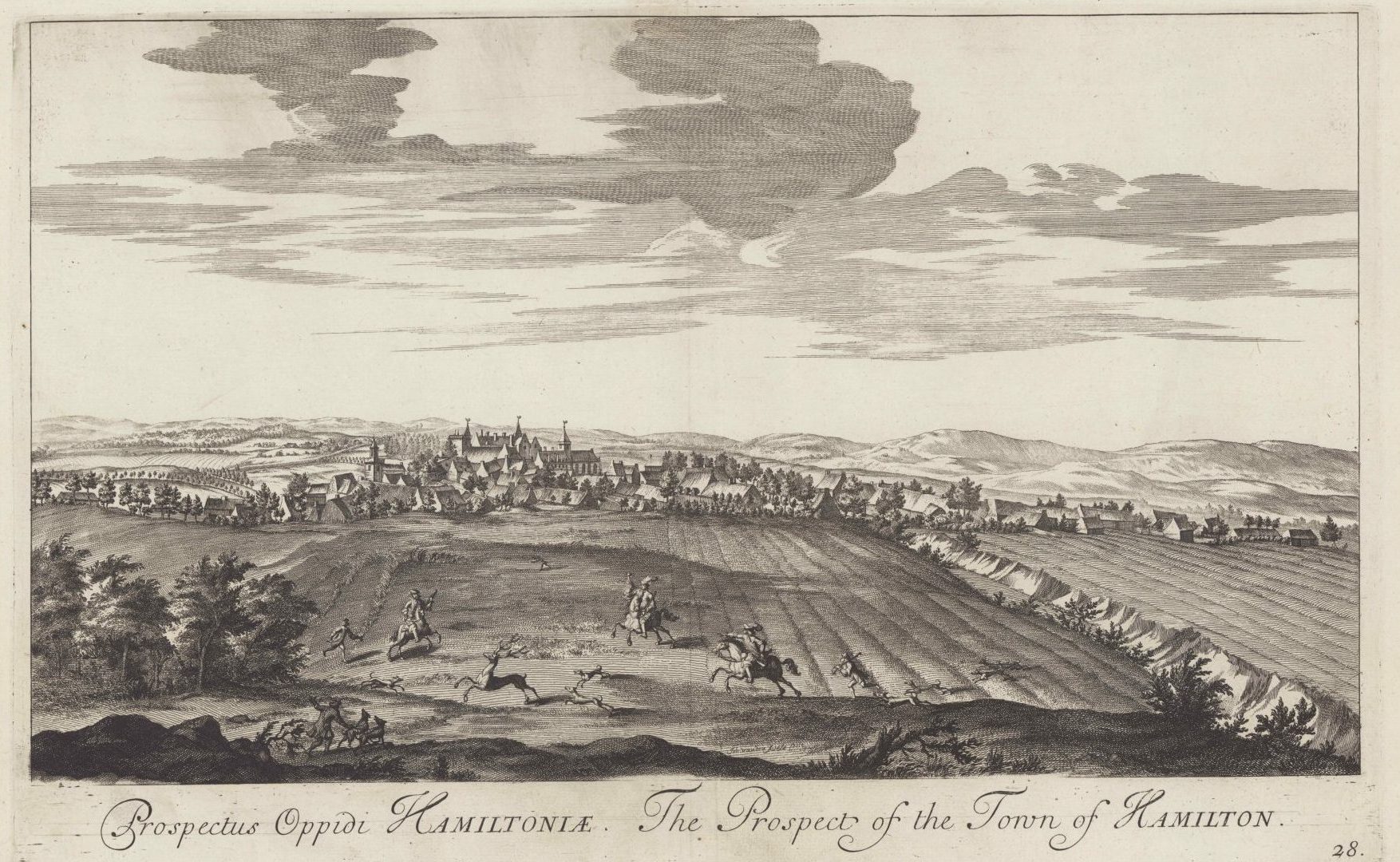
Hunting, whether for sport or survival, was inextricably tied to land and embodied the tensions between landowner and tenant. By the point in which the 1685 Game Act was passed, it was in the early years of the aforementioned new movement of landowners industrialising their landholdings to maximise profits. Hopetoun stands as a shining example of this movement. Construction of the house began in 1699 and the enclosure of the surrounding landscape began in 1700. While manicured formal gardens immediately surrounded the house, parks specifically devoted to arable and pastoral agriculture were also included just beyond (but out of sight of) the house. However, the sport of hunting was also integrated into this system. Stables, a dog kennel, a hawk house, and living quarters for a falconer were included in the construction of the Hopetoun House complex from the earliest years of its existence at the start of the eighteenth century. At one point in the 1710s, two deer parks existed simultaneously, as well. The sport of hunting was evidently a big point of consideration in Hopetoun’s design from the outset. However, it was also not limited to special parks: landowners had the ability to cross into agricultural enclosures should good game have been found in those spaces. This reinforced the performative nature of the sport, with hunters very visible to those who laboured the estate. Hunting blurred the line between the agricultural and formal spaces of the estate. The country house and its environs signified the power the landowner held over his property and the movement and activity of people within its confines.
As I mentioned at the start of the essay, my book, The Estate and the Country House in Scotland, Circa 1700: a Case Study of Sir William Bruce’s Hopetoun House is due to be published by Edinburgh University Press in September 2026. If you would like to learn more about Hopetoun House click the link above to find a full synopsis.
For more historical learnings, try one of our recommended readings here:
Leave a Reply