
Florence’s urban history is intertwined with the art that emerged from the Renaissance. Michelangelo’s David is a shining example yet it is also tied with our contemporary visual culture and collective consciousnesses. It’s a very famous and well-known object. But just because we can identify an object does not mean that we understand what it means or its historical significance. We really cannot begin to understand why it had such an immediate and sweeping cultural impact without delving into Florentine history. This essay aims to outline the urban development of Florence in a way that makes it easier to understand and analyse Renaissance objects such as Michelangelo’s David.
Florence in Antiquity
The region of Tuscany was originally the heart of the Etruscan kingdom (Tuscan derives from Etruscan). There are few of them, but it’s possible to visit some Etruscan archaeological sites. Florence itself was founded as a Roman military colony in 59 BC/BCE above the Etruscan village of Faesulae (which is Fiesole today) called Florentia. The very oldest sections of medieval Florence were either built on top of or integrated into those Roman sections: the 11th-century Baptistery was built on top of the temple of Mars; the original outline of the amphitheater became a group of thoroughfares; the squared off streets in the very heart of the city were what was once the ancient Roman protective walls. The presence of an amphitheater and baths by the height of the empire highlights its significance as a provincial capital.

Early Medieval Florence
Following the collapse/contraction of the Western Roman Empire, it was occupied by the Ostrogoths in the 5th century, the Byzantine Empire in the 6th century and then the Lombards later in the same century. Charlemagne conquered the city in 774 and subsequently absorbed it into the Holy Roman Empire. The Italian sections were made into a single kingdom and then divided into provinces called marches. Tuscany became one of those marches, with Lucca being the capital and Florence a separate city within the province. It merged with Fiesole as one county in 854 and continued to flourish thenceforward.

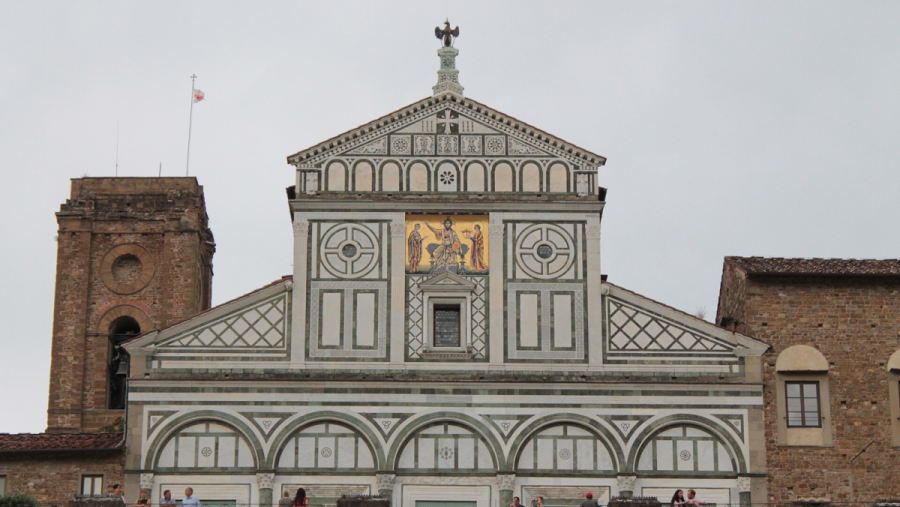
Margrave Hugh of Tuscany chose Florence as his residence in 1000. It was during this period that Florence began to surge and it’s reflected in the extant buildings of San Miniato al Monte (b. 1013) and the Baptistery (ca. 1059-1128). Both are built in the Romanesque style, reflecting the trade and political networks of the Holy Roman Empire (Romanesque architecture first appears in Germany, the core of the Holy Roman Empire.

Examples: St Cyriakus in Gernrode and St. Michael’s Cathedral). Just quickly, it’s obvious that the ornamentation of the churches are all different. However, the structures are essentially the same (keep in mind that these churches are about 1,000 years old so changes were inevitably made). Each has a nave surmounted by timber roofs with side aisles with separate timber roofs. Stout, one-storey arcades support thick walls that divide the naves and side aisles; this keeps the main spaces open while supporting the main structures.

Transverse arches divide the choirs, including apses/chevets, from the naves. This has a liturgical function because the nave was reserved for the lay public while the choir was reserved for clergy. It also had a structural function because it supported the extension of the building while dividing it spatially. This is an elementary form of Romanesque architecture and it reflects Florence’s import within the borders of the Holy Roman Empire.


Anyway, Countess Mathilda had a particularly important impact on Florence’s continued revival and it then became an autonomous commune following her death in 1115. It continued to prosper through international trade until invaded and conquered by Frederic Barbarossa in 1185. It managed to reclaim that independence in 1197.
Leave a Reply